Research
Usability is where we start. We design experiences on two stages — screens and virtual space — and follow them through to the affect they leave behind.
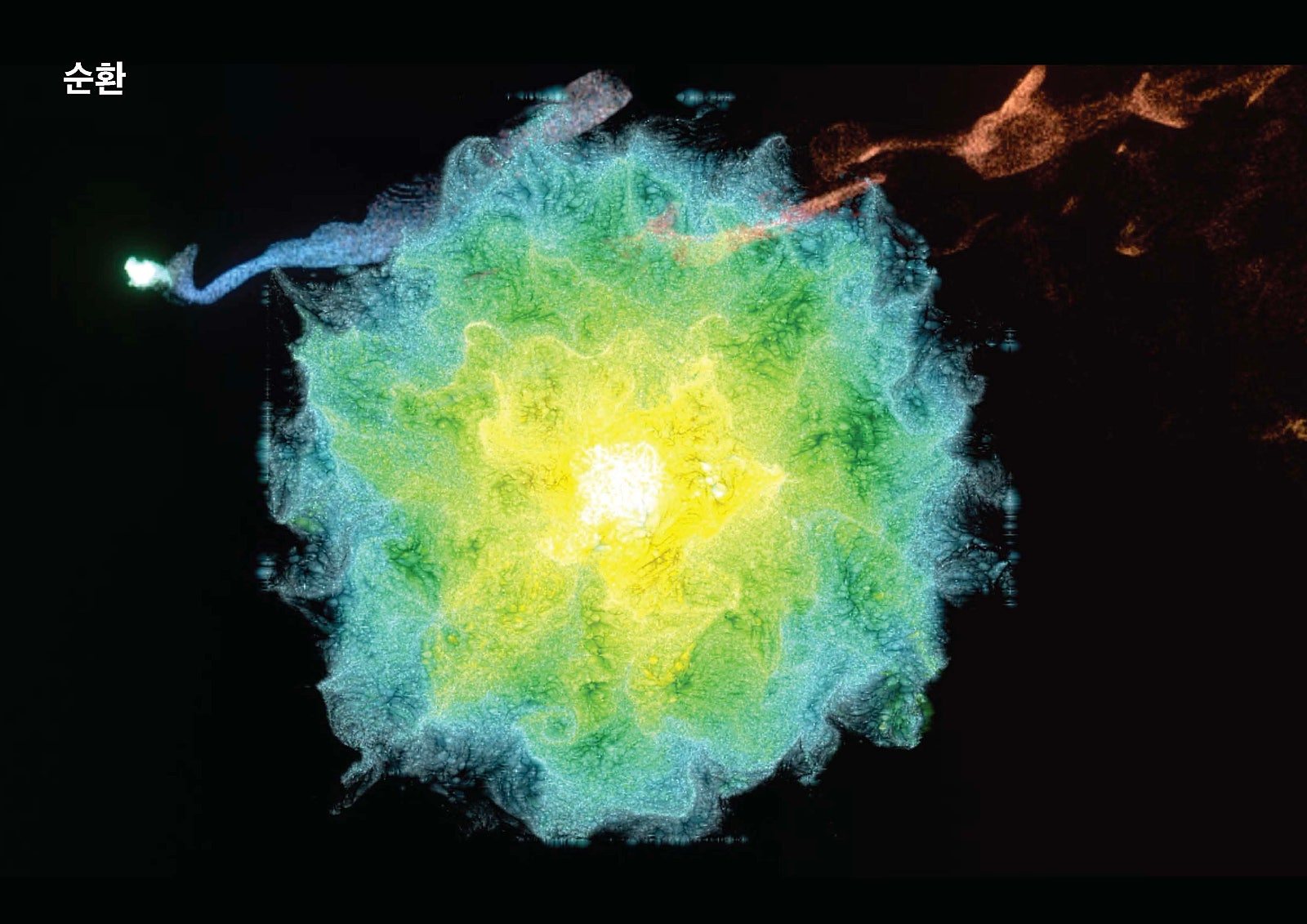
Cycle, a TouchDesigner student work
Form + UX
making what is seen, designing what is felt
materialwith what
AImakes the stimulus and plays the other party5Intuitionwhere the designer's eye decidesGame enginea 3D world built one condition at a timeTouchDesignerturns signals into live graphics
stagewhere
- Form
- Working on affect sometimes means experimenting with form itself — turning sensations that resist description, like pain, into three-dimensional shapes; visualising music as a growing pattern; putting the result in an exhibition. This is where the formal experiment of visual design becomes a research method.
- UX
- UX is not a stage but a method: designing what someone goes through, then finding out whether it landed as intended. Both stages are UX research — being on a screen does not make it UX any more than being in space makes it not.
- AI
- Generative AI is a material for making stimuli and an agent to interact with. We do not study AI for its own sake; it always arrives paired with affective measurement. That is why it is a material here, not an umbrella.
- UI
- How interfaces and services shift judgement and mood — feedback in an app, the wording of an emergency alert, usability on the web. 7 of our 18 papers sit here.
- XR
- Virtual and augmented environments let us change one thing at a time and watch the response — how much fear shifts when only the lighting changes.
- Affective
- The constant. We treat affect as a measurable state rather than a feeling: read the current coordinate, name the one the design is aiming for, then work out how to move between them. The stage changes; this question does not.
- Visual Experience
- What people see, and how they take it in: the width of a virtual character's face, the readability of a pass-through display, where the eye settles, and the 3D glyphs and phyllotactic patterns we make from pain and music. The question is how form and layout change the impression and the affect of the person looking. Here the things we make through form are put to measurement.
How we measure
Three layers. A survey takes what a person can say; behavioural logs catch what they cannot put into words — where they lingered, what they chose. EEG comes out when the two disagree.
Whichever layer, one condition changes at a time, or nothing can be said about the cause. No neuroscience needed to start: surveys and logs first, deeper when the question asks.